
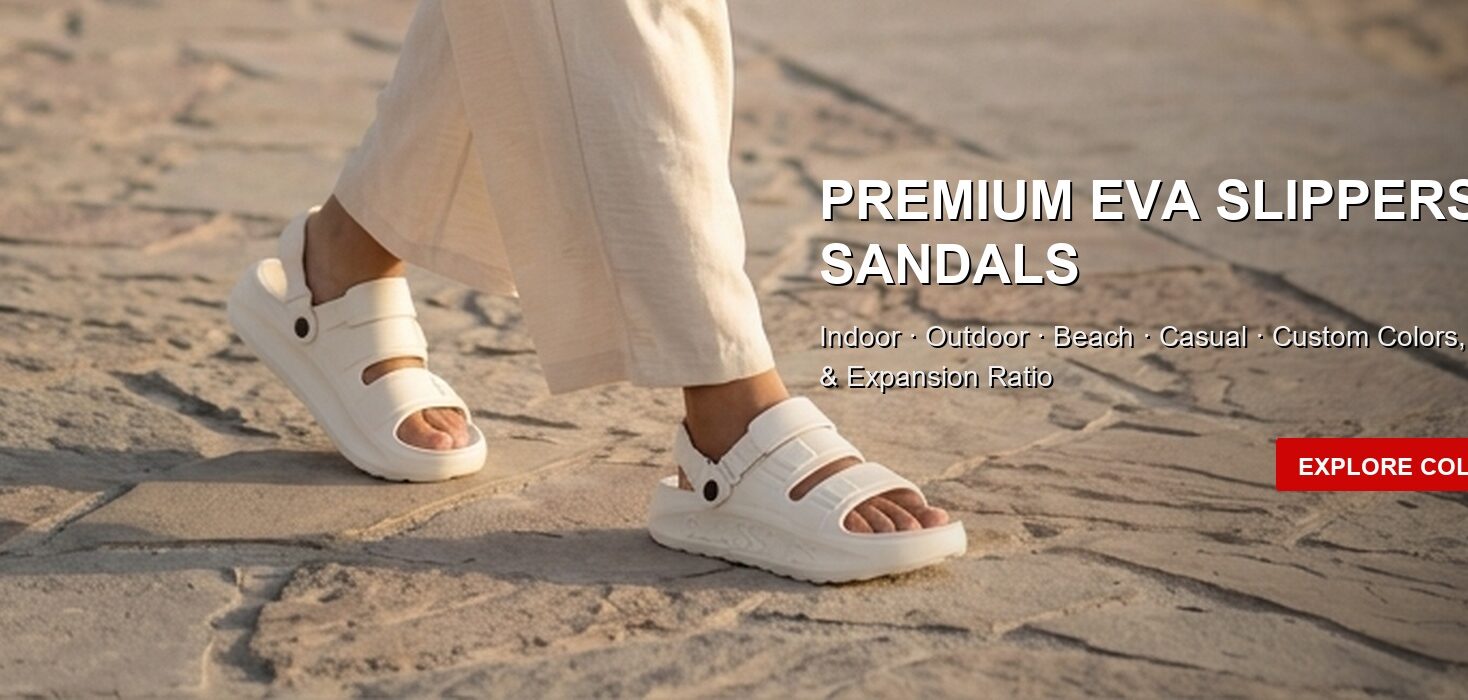
Have you ever wondered what happens between raw plastic pellets arriving at our factory and finished slippers being loaded into a shipping container? The journey involves precision engineering, skilled craftsmanship, and rigorous quality control at every stage. This article takes you inside the BJ Slippers manufacturing facility to walk through the complete production process.
Stage 1: Raw Material Preparation
Production begins with EVA resin pellets, pigments, and additives arriving at our material warehouse. Each batch undergoes incoming inspection to verify density, melt flow index, and moisture content. Materials that pass inspection are transferred to the compounding area, where they are mixed in precise ratios using high-intensity mixers. The compound is then pelletized and stored in climate-controlled silos to maintain consistency.
Stage 2: Mold Preparation
For each slipper style, we use custom-designed injection molds made from aircraft-grade aluminum. Mold design is a critical step that determines the final product shape, surface texture, and dimensional accuracy. Our in-house tooling department uses CNC machining to produce and maintain molds, ensuring they remain within tolerance throughout their production life. Before each production run, molds are cleaned, inspected, and pre-heated to the optimal temperature.
Stage 3: Injection Molding
This is where the magic happens. The EVA compound is fed into an injection molding machine, where it is heated to 160-190 degrees Celsius and injected into the mold cavity under high pressure (80-120 bar). The mold is then cooled to 40-60 degrees Celsius to solidify the foam. Each injection cycle takes 3-6 minutes depending on product size and density.
Our facility operates 12 injection molding machines with capacities ranging from 200 to 600 tons. Each machine is monitored by trained operators who perform hourly quality checks on dimensions, weight, surface finish, and color. Any deviation from specifications triggers immediate machine adjustment before the next cycle.
Stage 4: Deflashing and Trimming
After demolding, slippers have excess material (flash) along the parting line where the mold halves meet. Workers use precision trimming tools to remove this flash, creating clean edges. This step requires skill and attention to detail, as excessive trimming can damage the product while insufficient trimming leaves visible imperfections.
Stage 5: Strap Assembly
For styles with straps, the next step is strap attachment. Straps can be made from EVA, PVC, fabric, or synthetic leather, depending on the design. Attachment methods include:
- Mechanical riveting: Strap is secured with a plastic or metal rivet through the sole
- Adhesive bonding: Industrial-grade adhesive bonds strap to sole under heat and pressure
- Integral molding: Strap and sole are molded as a single piece (for specific designs)
- Heat welding: Strap is fused to sole using ultrasonic or thermal welding
Each method has specific advantages in terms of durability, aesthetics, and production speed. Our engineering team selects the optimal method based on the product design and performance requirements.
Stage 6: Decoration and Branding
For OEM/ODM orders, this stage involves applying custom logos, patterns, or decorative elements. Techniques include:
- Embossing/debossing: Logo is pressed into the EVA surface using heated dies
- Screen printing: Multi-color logos are printed on straps or soles using specialized ink
- Heat transfer: Pre-printed designs are transferred using heat and pressure
- Water transfer: Complex patterns are applied using water transfer printing technology
Stage 7: Quality Inspection
Every pair passes through multiple inspection points before packaging. Our inspection protocol includes:
- Visual inspection for surface defects, color consistency, and strap alignment
- Dimensional check using calibrated gauges (length, width, thickness)
- Weight verification to ensure consistent material density
- Hardness test using Shore C durometer
- Adhesion test for strap attachment strength
- Random sampling for AQL 2.5 statistical inspection
Stage 8: Packaging
Approved products move to the packaging area. Packaging options range from simple poly bags to custom retail boxes. For export orders, products are typically packed in master cartons with 50-100 pairs per carton, depending on size and style. Each carton is labeled with style number, size, quantity, and carton sequence number for easy identification at destination.
Stage 9: Pre-Shipment Inspection and Container Loading
Before container loading, we conduct a final inspection of packaged goods. Photos and videos are taken to document product condition and packing quality. Cartons are then loaded into containers systematically, with heavier cartons at the bottom and lighter ones on top. Container seals are applied and recorded for security.
Continuous Improvement
Our manufacturing process is not static. We continuously invest in equipment upgrades, process optimization, and worker training. Recent improvements include automated deflashing machines that reduce labor by 40%, real-time production monitoring systems that track machine performance, and a digital quality management system that eliminates paper-based inspection records.
Conclusion
Manufacturing quality slippers is a complex process that requires precision at every stage, from raw material preparation to container loading. At BJ Slippers, our vertically integrated facility ensures that every step is controlled, monitored, and optimized for quality. By keeping all processes in-house, we can maintain consistency, reduce lead times, and respond quickly to custom requirements. Want to see our process in action? Contact us to arrange a virtual factory tour.